

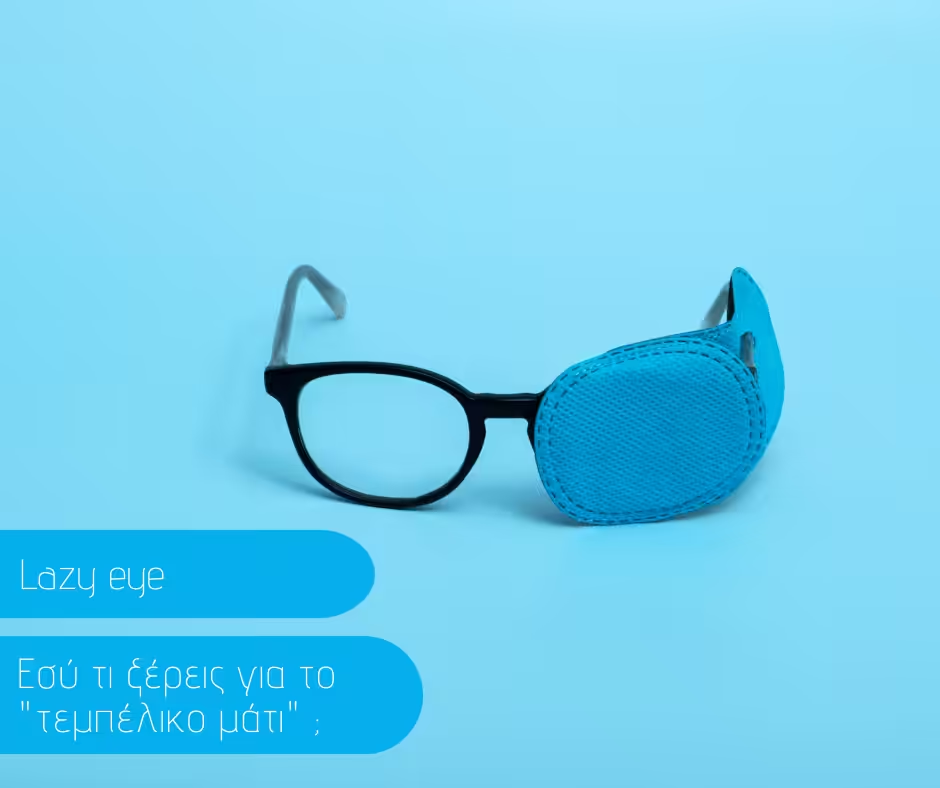
If the term “lazy eye” sounds strange, leave the laziness aside and keep reading!
“Lazy eye” is the everyday term for amblyopia, an eye condition in which the affected eye is essentially “not chosen” by the brain.
What actually happens is that one eye (usually only one) fails to focus properly, sending inaccurate visual information to the brain. This results in the brain’s “rejection” of this blurred input.
This neurological dysfunction affects about 5% of the population and appears in early childhood. It’s important to understand that if amblyopia is not diagnosed and treated early, there is no way to correct it later in life. The brain’s “visual learning” occurs only during the first nine years of life.
Think of the brain as a malleable entity: if it doesn’t receive the right visual training tools early on, it will not be able to reprogram itself later — even if the optical input becomes clearer.
The types of amblyopia are as follows:
- Anisometropic amblyopia: A refractive error where the two eyes have different prescriptions, causing the brain to receive mismatched images it cannot merge.
- Strabismic amblyopia: Caused by misalignment of the eyes (strabismus), leading to a permanent decrease in visual acuity in the affected eye.
- Deprivation amblyopia: Results from reduced visual input in infancy or early childhood, often due to cloudiness in the optical media (e.g., cataract), and can affect both eyes.
In the case amblyopia is diagnosed, the child and their parents need patience, discipline, and consistency in following one or more of the following approaches:
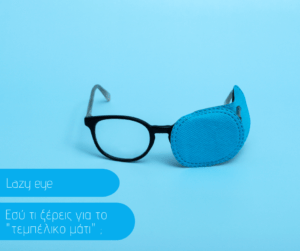
- Patching of the “good” eye. By covering the eye that sees well, we push the lazy eye — and the corresponding anatomical area of the brain — to try harder and eventually begin the proper reception of stimuli that until that point were not being correctly received. (Covering is recommended for 2 hours per day during moments of creative activity, such as drawing, reading, or playing.) It is very important that this training of the affected eye takes place under the constant supervision and guidance of a specialized doctor.
- Atropine eye drops. In certain cases, the use of drops that temporarily blur the “good” eye is recommended, so that the brain focuses on gathering visual information from the “amblyopic” eye, thus functioning as an alternative to patching in cases of the child’s non-compliance.
- Use of eyeglasses or contact lenses. The effectiveness of this option is lower and not always successful, yet it corrects the myopic or hypermetropic deviation between the two eyes.
- Surgery. Without constituting a direct treatment, such a method is indicated in cases of strabismic amblyopia, offering alignment of the eyes and improvement of binocular cooperation.
- Electronic glasses (amblis). These, for short periods of time, blur the healthy eye in a programmed manner, resulting in the burden of vision falling on the affected eye.
Whichever method one chooses, the most important piece of information concerns the age limit and the importance of timely treatment of amblyopia (up to 9 years old for strabismic amblyopia and up to 10 for anisometropic).
The key milestones for children’s eye exams are:
- 1st day of life
- 1st year of life
- 3rd year of life
- Every 2 years thereafter
Preventive eye check-ups, encouragement, and a creative cooperation with the child can ensure that lazy eye becomes a thing of the past!