


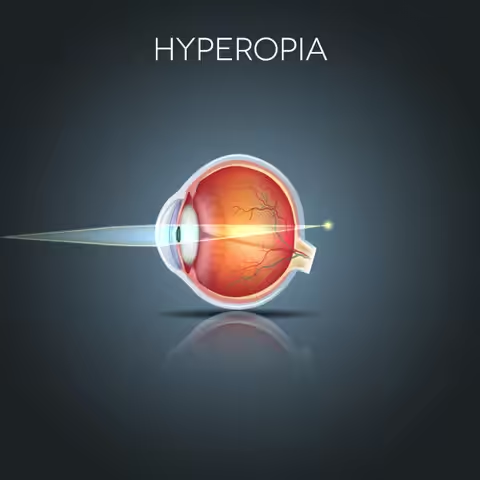
Hyperopia is a common refractive error in which light rays from the external environment, and thus the images of objects, do not focus on the back of the eye, that is, on the retina as in normal emmetropic eyes, but behind it. As a result, both near and distant objects appear blurred.
Hyperopia usually appears from birth. However, due to the eye’s accommodation reflex, it may diminish during childhood and adolescence or begin to cause issues again around ages 35–40. Presbyopia tends to appear earlier in hyperopic individuals.
Accommodation is the eye’s ability to focus on near and far objects despite the refractive error. The range of accommodation is very large in children but gradually decreases during adulthood. When the loss of accommodation becomes significant enough to cause problems with near vision, presbyopia begins.