


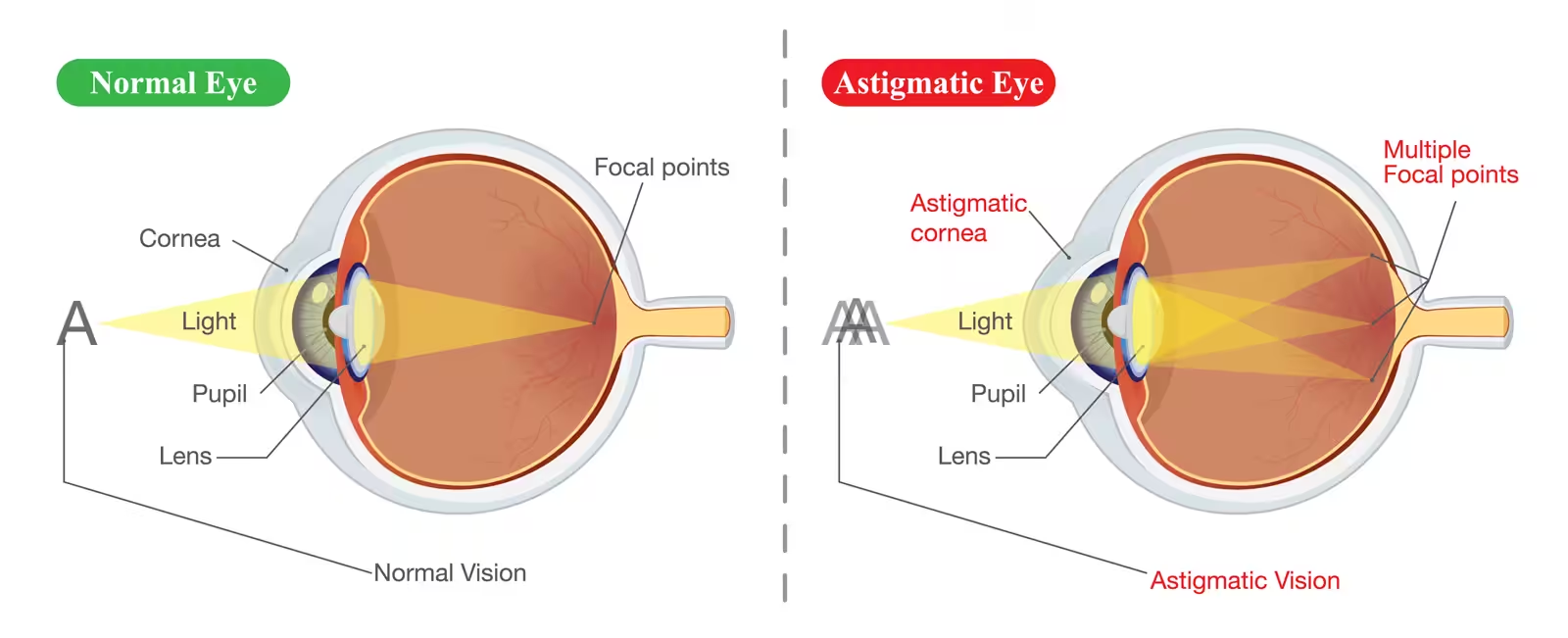
Astigmatism is a refractive error of the eye in which the patient perceives blurred vision. This occurs because the light rays and the image being viewed do not focus on a single point on the retina, but rather on multiple points—in front of, behind, or around it.
The condition is usually caused by the irregular curvature of the cornea, which has an elliptical rather than a perfectly spherical shape, or more rarely, by an irregularity in the lens of the eye.
Astigmatism often increases during childhood and tends to stabilize in adulthood. In some cases, however, it may continue to progress abnormally. Such progression should be further investigated with corneal topography and thorough clinical evaluation, in order to rule out associated conditions such as keratoconus.
The main symptoms of astigmatism are:
To correct astigmatism, the ophthalmologist prescribes eyeglasses or contact lenses, which significantly improve vision. In many cases, and if the patient meets all the necessary criteria, the ophthalmologist may also recommend and perform a surgical procedure for the permanent correction of astigmatism. The surgery is performed within a few minutes in a clinic, without requiring hospitalization. The patient can return to work and daily activities within 2–3 days after the procedure.