

Cataract surgery is considered one of the most successful and reliable surgical procedures. Vision is restored in a very short period of time, and the results are often spectacular.
CATARACT SURGERY AND IMPROVEMENT OF QUALITY OF LIFE
According to recent studies conducted, it is clear that patients who underwent cataract surgery reduced their likelihood of being involved in a car accident by 50%. Those who did not wish to undergo surgery drove much less than those who had already been operated on and covered about half as many kilometers as they did. This fact indicates that cataracts significantly limit people’s mobility and daily living. This limitation in driving—a skill that is usually needed daily in the lifestyle of modern people due to distances or work—greatly affects the quality of life of someone who wishes to be autonomous, capable, and active in their everyday life.
Despite the many benefits gained by the patient who undergoes cataract surgery—for example, the ability to drive and to carry out many activities in their daily life, as well as the improvement of their psychological state—there are many patients who hesitate and do not wish to be operated on. This postponement may be due to a lack of support from their family environment, their need to address other chronic conditions that trouble them, or the fact that they have a mistaken impression about the surgical process, the time required, and the recovery method, believing that it will take a long time to return to their daily life after cataract surgery.
Nowadays, cataract surgery is performed painlessly, without the need for hospital admission, and the patient will be able to return to their daily activities within a few days.
Cataract. What is it?
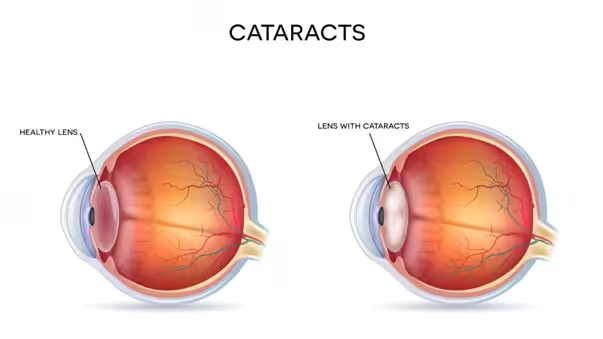
It appears when the accumulated protein of the eye’s lens causes clouding that makes vision difficult.
It is, therefore, the clouding of the eye’s natural lens. A normal, healthy lens is transparent, and as light passes through it, it is directed to the retina and macula to create normal vision.
The clouding of the lens may reduce vision, disturb color contrast—meaning colors will no longer appear as vivid as before—and, in general, cause the person affected difficulties in their daily activities.
The more intense and advanced the degeneration of the lens (clouding) is, the more impaired the vision becomes, and consequently, the patient’s quality of life deteriorates.
Cataract Surgery Kalamata
Causes
- AGE
- Previous eye injury (traumatic cataract)
- Previous ocular inflammation
- Cataract due to metabolic diseases (diabetes mellitus, hypocalcemia syndrome, etc.)
- Toxic or pharmaceutical factors (use of cortisone, pilocarpine, cholesterol control medications, smoking, alcohol, hormone therapies, etc.)
- Secondary cataracts (from chronic iridocyclitis, acute glaucoma, high myopia, etc.)
- Congenital cataracts (from rubella, toxoplasmosis, etc.)
- Hereditary cataracts
- Presenile cataracts in younger patients
- Ultraviolet radiation
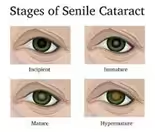
The most common type is the age-related cataract. According to studies conducted, among people aged 65–70, one in two presents with cataract—a percentage that increases to 70% in people over 75 years old.
Lens clouding is the most common cause of reduced vision in people over 40 years of age.
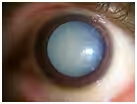
Symptoms
One of the first symptoms is a change in eyeglass prescription within a short period of time since the last examination.
Difficulty reading, clearly recognizing faces or images on television, as well as difficulty driving, are common.
If the cataract is central, it manifests with discomfort in bright light and relative myopia, which considerably improves near vision.
CATARACT PROGRESSION. Can it be prevented?
It is not completely known what causes this degenerative condition. However, we can delay its onset if we:
- Avoid ultraviolet radiation
- Stop smoking
- Regulate metabolic diseases such as diabetes mellitus
- Adjust our dietary habits. The Mediterranean diet, and in general, a diet rich in vegetables, may have beneficial effects.
When should cataract surgery be performed?
When symptoms begin, prescribing new glasses for reading or distance may help the patient, but only for a short time, as the cataract progresses and the prescription may continue to change.
Many patients mistakenly believe that the decrease in vision is simply a consequence of their age.
However, this is not exactly the case. They should know that cataract surgery is a painless procedure that restores vision to normal, pre-cataract levels. It is the most frequent and most successful surgical procedure performed in the United States, with over 3,000,000 patients undergoing cataract surgery annually.
The patient should undergo cataract surgery when it is their own desire to improve their visual acuity and the quality of their vision, as well as to return to their pre-cataract activities.
With the new microsurgical method of operation, this condition should be operated on when the cataract has reduced the patient’s vision by 50%. In cases of very advanced clouding and increased hardness of the lens, the level of surgical difficulty becomes greater, and the likelihood of intraoperative complications increases.
Therefore, when someone finds it difficult to drive at night, to read, or to watch television, it may be the right time to proceed with cataract surgery.
THE CATARACT OPERATION:
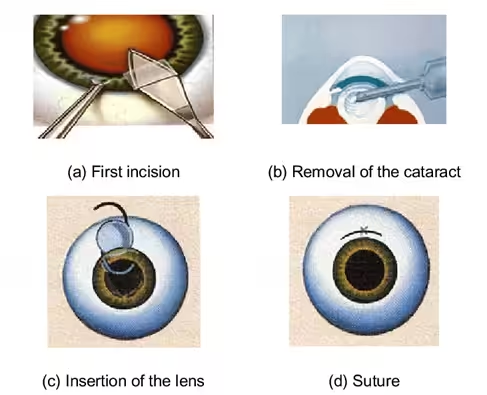
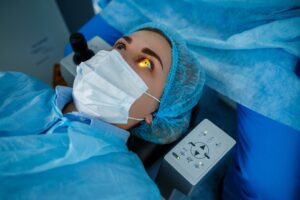
Surgery is the only way to treat cataracts. During the operation, the cloudy, hardened lens is removed using the phacoemulsification method (that is, the method of lens fragmentation) and replaced by a permanent artificial intraocular lens. All of this is done through microscopic incisions. The intraocular lens remains in the eye for the rest of the patient’s life.
There is a possibility of clouding of the natural membrane of the eye (posterior capsule), and the patient may experience cataract-like symptoms again. In such cases, a one-time laser cleaning of the posterior part of the lens is required.
Common questions about cataract surgery
- Does the surgery require general or local anesthesia?
Cataract surgery using the phacoemulsification method does NOT require general anesthesia. It must be individualized depending on each patient’s cooperation level. It is completely PAINLESS and is performed using local anesthetic eye drops or, in more difficult cases, a local anesthetic injection.
- How long does cataract surgery last?
The actual surgical time is about 15–20 minutes. However, a preoperative evaluation and medical history from the anesthesiologist of the department are required. The operated patient will also need to remain at the clinic for a safe period after the surgery.
- Does the operated eye need to be covered with gauze?
The operated eye is not covered with gauze, and the patient can leave wearing only sunglasses.
- When will one see clearly after cataract surgery?
Vision begins to clear a few hours after cataract surgery. The result stabilizes after the first 20 days.
- What should one avoid after surgery?
In the first period, the patient should follow the prescribed postoperative treatment and avoid the following:
- Rubbing the operated eye with pressure
- Prolonged bending over
- Swimming and intense physical activity
- Getting the operated eye wet
Intraocular lenses
The aspheric lenses (aberration-free) we use in cataract surgery improve vision under different lighting conditions, helping mainly drivers to drive with greater safety and confidence.
In a study conducted under nighttime driving conditions, drivers with aspheric intraocular lenses saw pedestrians crossing a crosswalk faster than those with conventional lenses. Consequently, they had the advantage of recognizing a pedestrian from afar and braking at a distance of 13.5 meters from them when their average speed was 60 km/h (0.5 seconds faster) compared to drivers with conventional lenses.
Aspheric intraocular lenses provide 31% better contrast under normal lighting conditions and 53% better contrast under low-light conditions compared to conventional lenses.
Which lens is most suitable for each case?
- Monofocal intraocular lens
This lens can correct distance vision. The patient will need glasses for near vision after surgery.
- Toric intraocular lens (astigmatism-correcting lens)
These lenses correct astigmatism. After surgery, the patient will be able to see very clearly without corrective glasses for distance, but will still need glasses for reading.
- Multifocal intraocular lens
These significantly reduce the need for glasses. The main feature of this lens is dual focus (near and far). The patient will eliminate the need for glasses for reading and for distance vision. However, these lenses cannot cover intermediate distance needs (such as computer use).
- Trifocal intraocular lens
It has the same properties as the multifocal intraocular lens. Its advantage is that it can also cover intermediate distances (computer use).
- Multifocal toric intraocular lens
These reduce the need for glasses. In addition to restoring near and distance vision, this lens also corrects astigmatism, thus providing the patient with higher quality postoperative vision.
WHAT GLASSES WILL BE NEEDED AFTER SURGERY?
In some cases, the patient will need glasses after cataract surgery. With proper preoperative evaluation and the right selection of intraocular lens, the likelihood of needing glasses is minimized.
CAN CATARACT REAPPEAR?
NO, because the natural lens of the eye is simply removed.
INSTRUCTIONS FOR CATARACT SURGERY
ON THE DAY OF SURGERY
The patient must inform the surgeon of any changes in their general treatment before the operation.
Because water must be avoided for several days after surgery in the head area, the patient should take care of personal hygiene in the previous days.
Clean your face and eyelids of makeup 2–3 days before the procedure using a liquid soap designed for facial cleansing.
- Solid food should be avoided for at least 12 hours before surgery, as well as liquids such as milk, cream, orange juice, etc.
- Two hours before surgery, the patient may drink clear liquids such as coffee or tea. Dairy products are prohibited.
- You must take your medications as usual before surgery, except for insulin, which will be administered after the operation.
Valuable items, personal jewelry, and watches should be left at home.
BEFORE SURGERY
For safety reasons, the clinic’s anesthesiologist will take a brief medical history before the procedure. The anesthesiologist’s assistant will place an intravenous catheter in your arm, which will be used in case of emergency or for possible sedation in cases of severe stress.
DURING SURGERY
Your face will be covered with a sterile surgical drape, and a special eyelid speculum will be placed in the eye to be operated on to prevent blinking during the procedure. After surgery, you will rest in your room for 30 minutes, where you will be given postoperative instructions as well as something to eat and drink.
First hours after surgery
After the procedure, you may watch television or even read, if that pleases you and does not cause any discomfort. You may resume your normal diet from the very first day.
Κολλύρια μετά την επέμβαση
From the first hours after surgery, the patient must begin using the prescribed eye drops. Their use should follow your doctor’s instructions. During instillation, the patient should not touch the upper eyelid but only the lower one, and the drops should be placed in the lower conjunctival sac.
If you must apply two eye drops at the same time, you should leave a 3–5 minute interval between them.
If you are a glaucoma patient, you must continue your other treatments as usual, always according to your doctor’s instructions.
What to avoid for the first 10–14 days
Cataract surgery is performed using micro-incisions. Healing and closure of the incisions occur without stitches, so the patient should take care during recovery to avoid the following:
Do not lift heavy objects.
Do not get the operated eye wet.
Avoid bending deeply forward.
Blurred vision, tearing, and often a foreign body sensation in the operated eye are normal during the first postoperative day.
AFTER THE SECOND WEEK
Healing is theoretically completed after the second week. A follow-up examination will then be carried out, and your new glasses will be prescribed if needed.
When should I worry?
Pain in the operated eye, persistent blurred vision that does not improve, and irritation with purulent discharge are symptoms that must be examined immediately.
If you experience any of the above, or if you notice intense flashes or a veil covering your vision, contact your ophthalmologist.