

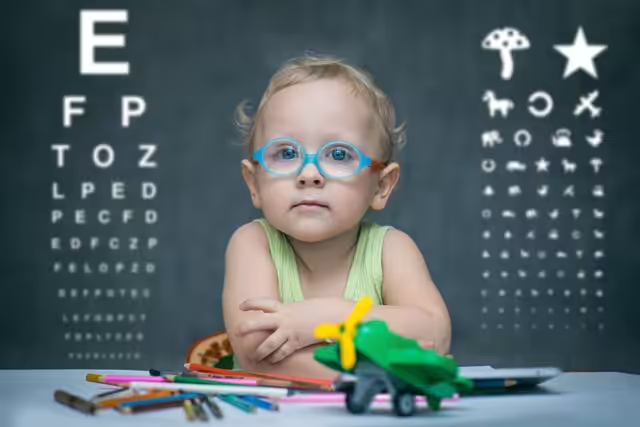
Ophthalmological assessment of children is essential and requires specialised knowledge and a careful approach. Vision is one of the most important human senses and begins to develop from the earliest years of life. Vision is a complex process in which the eyes must learn to work together with the brain and mature properly. This maturation takes place and is completed during the first 8–9 years of a child’s life.
Therefore, the significance of ophthalmological examinations during childhood is substantial. Various problems that may arise during this period can negatively affect visual development and potentially lead to reduced visual acuity throughout life.
Paediatric Ophthalmology is a specialised branch of Ophthalmology focused on examining the visual system of children, diagnosing issues, and providing treatment. A paediatric ophthalmologist can monitor, assess, and perform surgical interventions for a wide range of conditions present from birth through to adulthood.
It is crucial that a child’s first eye examination is conducted by a paediatric ophthalmologist before the age of three. This enables early diagnosis and management of conditions that may be developing. Early detection is particularly important because children rarely complain if they have impaired vision or eye discomfort. Neonatal examinations typically use indirect ophthalmoscopy, which can identify conditions such as congenital cataract, congenital glaucoma, and other eye disorders.
The second examination should take place between the ages of 2 and 3, during which the child’s refraction is assessed for conditions such as myopia, hyperopia, and astigmatism.
If the child has no other visible conditions (e.g., strabismus), the next examination is usually scheduled around the age of four, before starting school. At this stage, visual acuity and colour perception are measured, and the presence of strabismus is evaluated.
Strabismus
What is strabismus?
Strabismus is a condition in which the eyes are unable to remain parallel and focus on the same target. Typically, one eye is dominant while the other deviates, though in some cases both eyes may alternate. Strabismus can appear very early, sometimes before six months of age (congenital strabismus). There are different types, including hypertropia (eye deviates upward), esotropia (eye turns inward towards the nose), exotropia, and others.
Early diagnosis is vital to prevent permanent complications, such as vision loss in the deviating eye, and to identify potentially more serious underlying conditions.
Causes
Strabismus may be caused by:
- Certain refractive errors (e.g., hyperopia)
- Heredity
- Neuro-ophthalmological conditions
- Illness or high fever
- Stressful emotional situations
Effects
Strabismus can significantly affect a child’s daily life and psychological well-being.
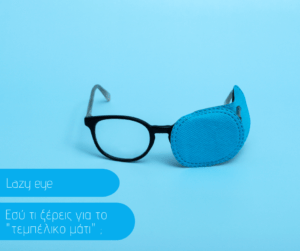
- Most importantly, it can impair vision, leading to amblyopia, also known as the “lazy eye,” as the deviating eye fails to develop properly.
- Depth perception may be compromised due to poor coordination between the eyes.
- The condition can also impact a child’s self-esteem due to the visible misalignment of the eyes.
Treatment
Treatment aims to restore and maintain good vision and to align the deviating eyes. After a comprehensive eye examination to determine the cause, the ophthalmologist can recommend the appropriate course of action.
In the case of refractive errors, the ophthalmologist prescribes glasses to achieve optimal vision. Occlusion therapy may be used, covering the “good” eye for a period each day to train the deviating eye and improve vision.
If glasses alone are insufficient in correcting the problem, surgical intervention may be necessary.
Surgery strengthens or weakens the eye muscles and repositions them to achieve alignment, using absorbable sutures. The procedure typically lasts 45–60 minutes and is performed under general anaesthesia in children. Postoperative care includes antibiotic and anti-inflammatory eye drops, and redness usually resolves within a few weeks.
Pseudo-strabismus
This common condition gives the appearance of crossed eyes in infants or young children due to a flat nasal bridge and epicanthal folds (skin folds at the inner corner of the eye). The eyes are, in fact, normal. This results in giving the false impression of strabismus.

Refractive Errors
What are refractive errors?
Refractive errors include myopia, hyperopia, and astigmatism, which cause blurred vision. Early detection and treatment are critical to prevent long-term visual impairment, as visual development continues until around 7–8 years of age.
Causes
These conditions are largely genetic and influenced by family history.
Symptoms
- The child cannot recognise faces or objects at a distance.
- They sit very close to the television or hold objects very near to observe them.
- The eyes may appear to deviate, potentially causing strabismus.
Treatment
Myopia, hyperopia, and astigmatism in children are usually corrected with glasses. In rare cases, contact lenses may be recommended. After adulthood, refractive surgery (laser) may be considered if certain conditions are met.
Congenital Cataract
What is a congenital cataract?
A congenital cataract is clouding of the eye’s crystalline lens, present at birth or developing within the first few months of life.
Causes
- Intrauterine infections (e.g., toxoplasmosis)
- Metabolic or chromosomal abnormalities
- Prematurity
- Hereditary factors
- Trauma
Symptoms
The most common sign is a white reflection in the pupil, easily noticed by parents or paediatricians. Sometimes cataracts can lead to strabismus, prompting diagnosis during strabismus evaluation.
Treatment
Early intervention of congenital cataract is crucial. This means that, following the diagnosis, the specialized ophthalmic surgeon must perform surgery within the first two months of the child’s life. In milder cases that do not significantly affect vision, conservative management with regular monitoring may suffice, with no need for surgical intervention.
Congenital Nasolacrimal Duct Obstruction
What is congenital nasolacrimal duct obstruction?
This condition causes excessive tearing in one or both eyes and is common in infants.
Causes
- Narrowing or blockage of the nasolacrimal duct at the valve of Hasner
- Delayed maturation of the nasolacrimal system
Symptoms
The main symptom of this condition is continuous tearing of the eyes. However, in some cases, tearing may be intermittent, or purulent discharge may be observed on the eyelashes and mucus inside the eye. Additionally, a red swelling may appear in the inner corners of the eyes, and more rarely, the area may become infected, leading to inflammation.
Treatment
The management and treatment of tearing is largely conservative during the first 12 months of life, due to the fact that the infant’s nasolacrimal system may mature within the first year. For this reason, and following the ophthalmologist’s guidance, parents need to clean the eye area where purulent or mucous discharge is present using a compress that has been moistened with lukewarm water. Intensive application of local massage to the nasolacrimal system helps maintain its patency. However, if symptoms do not resolve within the first year of the infant’s life, surgical intervention may be necessary—specifically, nasolacrimal duct probing, during which a small catheter is inserted into the tear duct and then flushed with saline. In cases where this procedure fails due to anatomical anomalies, a dacryocystorhinostomy is performed at an older age, around 4–5 years. In this surgery, the ophthalmic surgeon makes a small incision in the nose to bypass the blocked nasolacrimal duct and connect the lacrimal sac to the interior of the nose. Both procedures are performed under general anesthesia but do not require hospitalization or overnight stay.
It is of utmost importance that parents understand the necessity of prevention. Early ophthalmologic and refractive screening in children can help prevent potential problems and play a significant role in the prevention of conditions affecting our youngest patients.